
- Dec 21, 2025
- 6 min read
5 Hard Truths About Starting an Online Business I Wish I Knew 10 Years Ago
The dream of starting a successful online business is more common than ever, but so is the deafening flood of advice that comes with it. A quick search unleashes a torrent of listicles, gurus, and "can't-miss" opportunities, making it nearly impossible to separate the signal from the noise. How do you find the advice that actually works?
This article cuts through the clutter by distilling a decade of hard-won experience from Greg Gottfried, a creator who has built multiple online businesses and generated "several million dollars in profit" along the way. These aren't the generic tips you'll find in a top-ten list. They are the surprising, often counter-intuitive truths he wishes someone had shared with him 10 years ago, specifically updated for the landscape of 2026.
--------------------------------------------------------------------------------
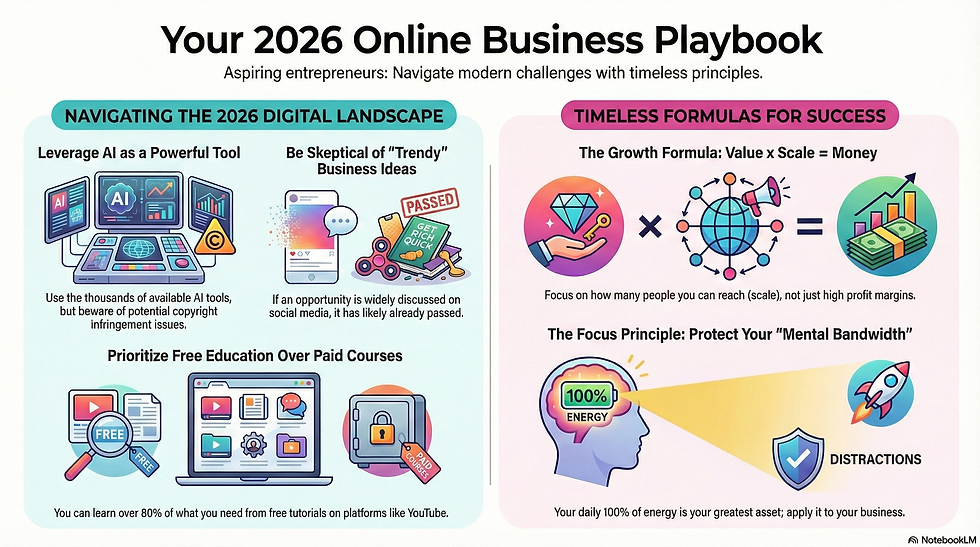
1. AI Is Not Just Your Assistant—It's a Potential Copyright Minefield
Of all the shifts in the online landscape, none is bigger or more double-edged than the rise of AI. Just a year ago, AI tools were in their infancy, but they have learned so quickly that they can now be extremely helpful for online business. This power, however, comes with two critical considerations. First, you must evaluate how AI could impact your chosen business model and potentially make it obsolete.
Second, and more urgently, is a risk not many people are talking about: copyright infringement. The AI models you use were trained on vast amounts of data, which may have included copyrighted materials. This creates a significant legal gray area, a point underscored by a warning on copyright from congress.gov:
"some outputs of AI programs might infringe copyrights in other works they resemble that were used to train the AI."
The practical advice is to use AI tools responsibly and with your eyes open. Always review the text and graphics AI generates. If an output looks too similar to an existing, recognizable work, it could be a potential issue. Be aware of the risks to avoid future headaches.
2. If a Business Idea Is Trending, the Real Opportunity Is Already Gone
When you're starting out, it's tempting to search for "the best online business ideas" and dive into the ones that appear on every list. This is almost always a mistake. Gottfried notes that he personally "wasted time, wasted money" pursuing many of these trendy ideas early in his career. The sheer volume of content recommending a specific business model is a major red flag indicating market saturation.
The critical litmus test for vetting online business advice is to look at who is giving it. Is the creator personally and successfully running the business they are recommending? If they can't show credible proof, be cautious about investing your time and money. The rule of thumb learned over a decade is simple but profound:
"if a lot of people are talking about a business opportunity or a business model, the opportunity has probably already passed."
Entrepreneurs who discover a genuinely profitable niche typically keep it to themselves until they have capitalized on it. However, this doesn't mean all advice is a scam. As Gottfried adds, once a truly good entrepreneur has found success, "they will turn around and try to teach other people how to do what they've done." The key is to find those genuine teachers, not the trend-chasers.
Avoiding saturated, trendy ideas frees you from the herd—and it also frees you from the expensive "get-rich-quick" courses often sold to that same herd.
3. That Expensive Paid Course? 80% of It Is Already on YouTube for Free.
A common business model for online creators involves using free content as a funnel to sell a high-priced course. They offer basic information in a free video or a 90-minute webinar, building excitement before pitching an expensive program. While some paid courses are valuable, you can often acquire the necessary knowledge without the hefty price tag.
A more effective and cost-efficient strategy is to leverage the wealth of high-quality free content already available. First, once you've chosen a business model, watch all the in-depth, free tutorials on YouTube from credible creators. This will provide "about 75, 80% of what you need to know." Then, learn the remaining 20-25% through hands-on trial and error while keeping your initial costs low.
Many creators produce comprehensive, course-level tutorials and offer them for free. The proof of their value is in the feedback from viewers.
"You will find people commenting that they paid thousands of dollars for courses and learned more in the free tutorial that's on my channel than they did in that entire course."
This reflects Gottfried's own mission: to be the type of creator he advises others to seek out—one who provides immense value for free based on businesses he is actively running. Ultimately, all the information you need is already out there. The key is finding the right sources and being willing to learn through a combination of free education and practical application.
4. You're Focusing on the Wrong Math: It’s Not Margin, It’s Scale.
This next insight is a simple formula that Gottfried wishes someone had shared with him on day one of his entrepreneurial journey. It comes from MJ DeMarco's book, The Millionaire Fast Lane, and it fundamentally changed his approach to business: Value x Scale = Money.
When starting out, many entrepreneurs make the mistake of obsessing over profit margins, believing that a higher profit per sale is the key to wealth. Gottfried calls this approach "entirely backwards." The true engine of growth in an online business is not margin, but the "Scale" part of the equation—how many people your business can reach and deliver value to. Gottfried emphasizes this point so heavily that he has broken it down in detail for his own community.
In 2026, this concept is more relevant than ever. The reach of the internet and social media platforms provides a potential for scale that is "so much higher than it's ever been." Your primary challenge, therefore, isn't maximizing profit on a single transaction. It's figuring out how to deliver genuine value to the enormous audience you can now access.
5. Your Greatest Asset Is Your "Mental Bandwidth" (And You're Wasting It)
Few people talk about the concept of "mental bandwidth," but it may be the single most critical factor in your success. The idea is simple: every day, you wake up with 100% of your energy and focus. This finite resource can be applied to anything—your business, your day job, or distractions.
There is a direct relationship between how you allocate this bandwidth and how quickly you see results. If you apply the full 100% to your online business, you will progress at the fastest possible rate. If you dilute it—giving 50% to your business and 50% to scrolling social media—it will take you twice as long to achieve your goals.
While some drains on your bandwidth are obvious, like social media, others are more hidden and just as destructive. These include:
• Overthinking your business plan
• Negative thoughts about why it might not work
• Stressing about finances
• Gossiping
• A bad night's sleep that leaves you tired
Protecting this 100% of energy and focus is paramount. By consciously directing your mental bandwidth toward productive work on your business, you create the conditions for rapid growth and success.
--------------------------------------------------------------------------------
Conclusion: Where Will You Invest Your Focus?
Succeeding in online business in 2026 is less about chasing the latest trend or buying the most expensive course, and more about adopting a smarter, more focused mindset. It requires understanding the real risks of new technologies, seeing past saturated markets, and valuing practical learning over expensive programs. Most importantly, it's about recognizing that your ability to scale value and protect your focus are your most powerful assets.
Knowing that your energy is your most valuable asset, what is the single most important task you will apply your full mental bandwidth to tomorrow?
📢 Business Resources You Can Use
✔ Get your website name — Bluehost
✔ Branding Services — Fiverr Pro
✔ Create a New LLC — MyCorp
✔ SEO & Market Research Tools — SEMRush
✔ Logo & Brand Design Services — 99designs
✔ Best Email Marketing Tool for Beginners — Constant Contact
✔ Accept Credit or Debit Cards — Square




Reading this really took me back to my early struggles balancing ambition and reality. As a current PhD student, I relate deeply to the harsh truths shared here. I’m also working part-time at Last Minute Assignments, where I assist students with their academic work, especially offering help with machine learning assignment UK. I’ve always had a strong desire to help others because, during my college days, I faced similar challenges and confusion, which made me more conscious about my studies and supporting others. Nice Post
I appreciate the honest insights in this article about the realities of starting an online business. It reminds entrepreneurs that building credibility online whether through services or platforms like the best CV writing services online also requires patience, consistency, and real value for clients.
I totally relate to this starting an online business can be exciting, but it’s easy to underestimate the challenges like managing cash flow, building an audience, and staying consistent. Planning ahead and learning from others’ experiences makes a huge difference. I think the same idea applies to authors trying to reach readers; many new writers look for affordable book marketing services to promote their work effectively without breaking the budget, especially when they’re just starting out.
This article is very helpful and well-structured. It explains Fairplay club and Fairplay pro , and overall usage in a simple and user-friendly way. I didn’t feel bored or overwhelmed at all. Definitely useful for anyone searching for Fairplay information.
I really liked how clearly everything was explained. The content flow makes it easy for new users to understand fairdeal live and the features of Fairdeal games without confusion. One of the most informative posts I’ve read recently. Great work by the Fairdeal india team.